





Today, New York City Landmarks Preservation Commission (LPC) Chair Lisa Kersavage joined Bronx Borough President Vanessa L. Gibson, New York City Councilmember Justin E. Sanchez, the New York Landmarks Preservation Foundation (NYLPF) Chair Tom Krizmanic, and Bronx Community Board 2 to unveil new markers commemorating the historic and architectural significance of the Longwood Historic District and District Extension in the Bronx.
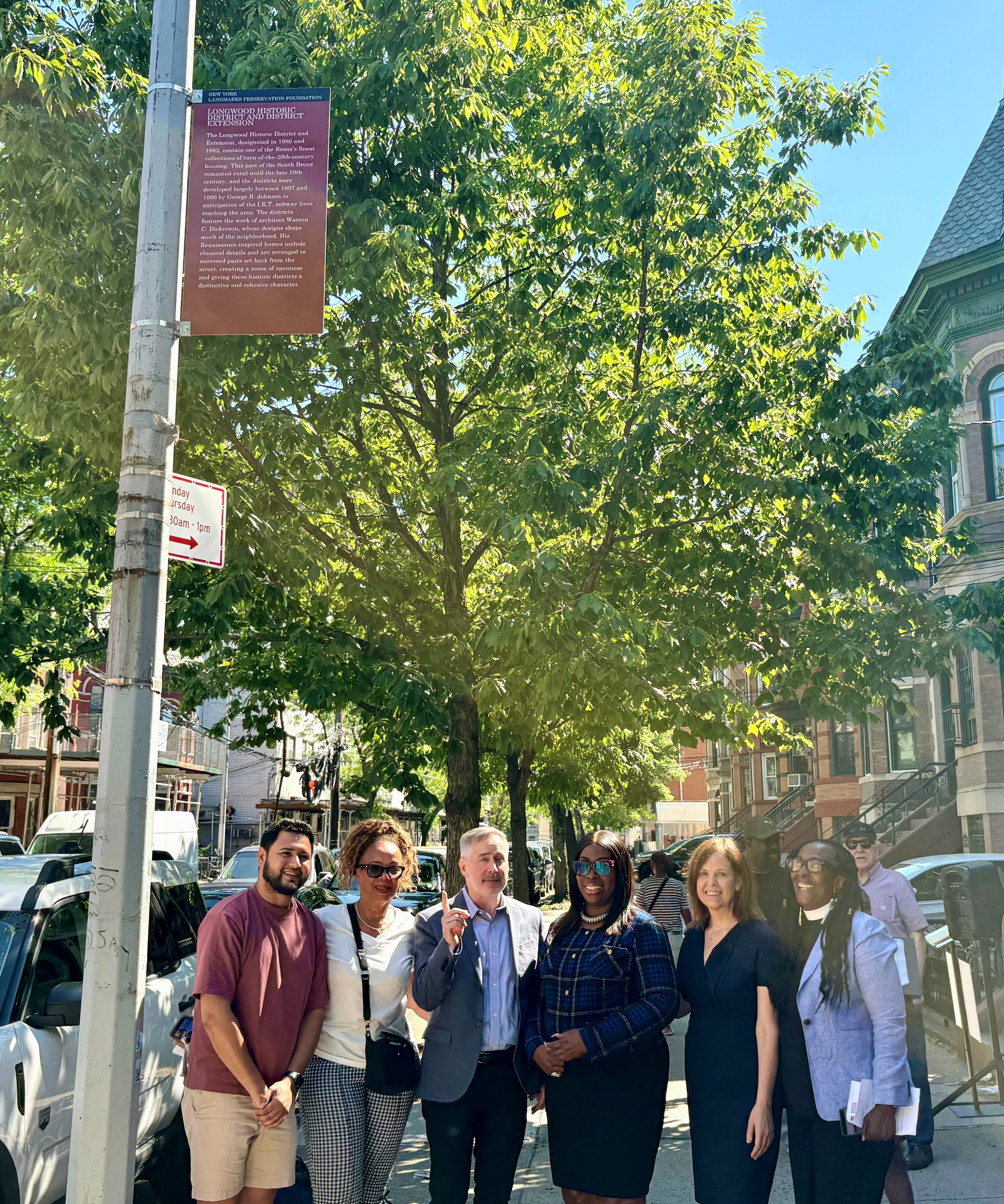
The Longwood Historic District and District Extension were developed at the turn of the 20th century in an area of the Bronx that had remained largely rural until plans for an IRT subway line connecting the Bronx to Manhattan were announced in the late 1800s. More than a century later, the two historic districts contain some of the finest examples of turn-of-the-20th-century architecture from that early period of residential development, and reflect the community’s long-standing stewardship of their historic streetscape. LPC designated the Longwood Historic District in 1980, followed by the District Extension in 1983.
“New York City’s rich design history is a valued resource for New Yorkers across the five boroughs. Thanks to these new historic district markers, Bronxites and visitors will be able to better appreciate the historic architecture and streetscape of the Longwood Historic District. I’m grateful for the work of residents, the LPC team, and the New York Landmarks Preservation Foundation for their work protecting these neighborhood treasures and helping even more people to learn about their important history,” said Leila Bozorg, Deputy Mayor for Housing and Planning.
“The Longwood Historic District and Extension, with their distinctive turn-of-the-20th-century architecture and cohesive streetscapes, remain a vibrant urban enclave in the South Bronx,” said Landmarks Preservation Commission Chair Lisa Kersavage. “The new markers unveiled today commemorate the importance of these districts and celebrate the residents who have ensured they are preserved for generations to come.”
“At a time when many Bronx communities faced disinvestment, residents fought to ensure Longwood’s historic character would endure. Their efforts helped preserve not only these buildings, but also a sense of place, identity, and pride that continues to define the neighborhood today,” said Bronx Borough President Vanessa L. Gibson. “I want to thank the Landmarks Preservation Commission, New York Landmarks Preservation Foundation, Bronx Community Board 2, and the community members and advocates who fought to preserve this neighborhood`s history and its impact on the Bronx. Today`s unveiling serves as a testament to our borough`s perseverance.”
“Here in the Bronx, people take pride in where we’re from. Our cross streets define us. Each block carries a legacy with stories passed down from neighbor to neighbor,” said Council Member Justin E. Sanchez, who represents Longwood in City Council. “These new historic markers will permanently enshrine this legacy and help color inside the lines of the stories we tell.”
“As both a homeowner in the Longwood Historic District and a member of Bronx Community Board 2, I am delighted to see these historic district markers installed in our community,” said Dr. Lucretia Jones, Bronx Community Board 2. “They are a visible reminder of the rich history, culture, and architectural significance of our neighborhood. We appreciate the Landmarks Preservation Commission’s commitment to preserving our historic district and look forward to working together to connect homeowners with resources that support preservation, strengthen our community, and enhance quality of life for residents.”
“Almost 130 years ago, the developers and architects of what is now the Longwood Historic District, must have imagined, due to the quality of design and materials used in their construction, that these homes would be occupied by many generations of Bronx residents,” said New York Landmarks Preservation Foundation Chair Tom Krizmanic. “The honored architecture in this neighborhood, contributes to the pride the residents have today – and celebrating with these new District Markers, today proclaims the protection of this pride into the future”
The Longwood Historic District and District Extension were largely developed by George B. Johnson, who purchased the land just west of Hunts Point after details of the IRT subway connection were publicized. Nearly all of the homes developed in the historic districts were designed between 1897 and 1900 by architect Warren C. Dickerson in the neo-Renaissance style popular at the time. The paired homes form a cohesive and distinctive streetscape, with Roman brick facades, ornate classical detail, and a picturesque turreted roofline.
Other notable buildings in the districts include the onion-domed 760-764 Hewett Place, constructed in 1906 for the Montefiore Hebrew Congregation; St. Margaret’s Episcopal Church at 940 East 156th Street, built around 1920, which replaced an earlier frame church designed by Dickerson; and 990 East 156th Street, built in 1850 as a private residence and later purchased by developer George B. Johnson for use as his real estate office. In 2005, LPC approved work at 990 East 156th Street that allowed for its adaptive reuse as part of a new residential building with affordable housing constructed adjacent to the historic property.
Today’s marker installation is part of the NYLPF’s Historic District Marker Program, which fosters public awareness and civic pride in designated historic districts in the five boroughs, and the markers are produced and installed by the NYC Department of Transportation. A total of four markers sponsored by NYLPF were installed today across Longwood Historic District and District Extension.
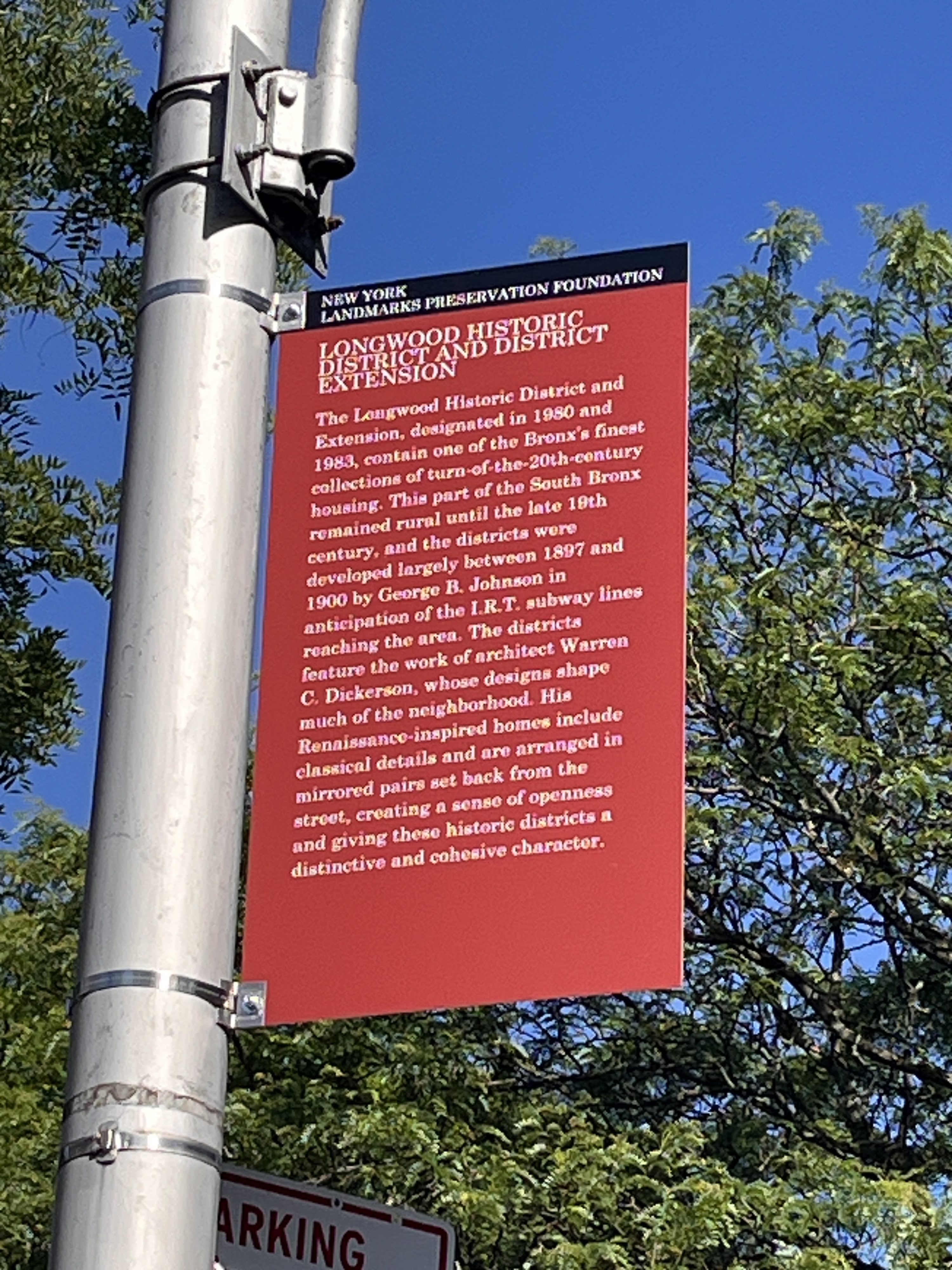
The newly installed markers are 19-by-36-inch terra cotta-colored signs and feature a map on one side and a brief description and history of the district on the other. The marker text reads as follows:
The Longwood Historic District and Extension, designated in 1980 and 1983, contain one of the Bronx’s finest collections of turn-of-the-20th-century housing. This part of the South Bronx remained rural until the late 19th century, and the districts were developed largely between 1897 and 1900 by George B. Johnson, in anticipation of the I.R.T. subway lines reaching the area. The districts feature the work of architect Warren C. Dickerson, whose designs shape much of the neighborhood. His Renaissance-inspired homes include classical details and are arranged in mirrored pairs set back from the street, creating a sense of openness and giving these historic districts a distinctive and cohesive character.
More Information:
Longwood Historic District designation report: https://s-media.nyc.gov/agencies/lpc/lp/1075.pdf
Longwood Historic District Extension designation report: https://s-media.nyc.gov/agencies/lpc/lp/1286.pdf
About the Landmarks Preservation Commission (LPC)
The Landmarks Preservation Commission is the mayoral agency responsible for protecting and preserving New York City’s architecturally, historically, and culturally significant buildings and sites. Since its creation in 1965, LPC has granted landmark status to more than 38,500 buildings and sites, including 1,473 individual landmarks, 125 interior landmarks, 12 scenic landmarks, and 159 historic districts and extensions in all five boroughs. For more information, visit LPC’s website and connect with us at Facebook, Instagram, X, and LinkedIn.
About the New York Landmarks Preservation Foundation (NYLPF)
The New York Landmarks Preservation Foundation is a not-for-profit organization that supports work that relates to the designation of New York City landmarks, including the well-recognized Bronze Plaque Program for individual landmarks, the Street Sign Program, and the Historic District Marker Program. For more information, please visit NYLPF.org.