



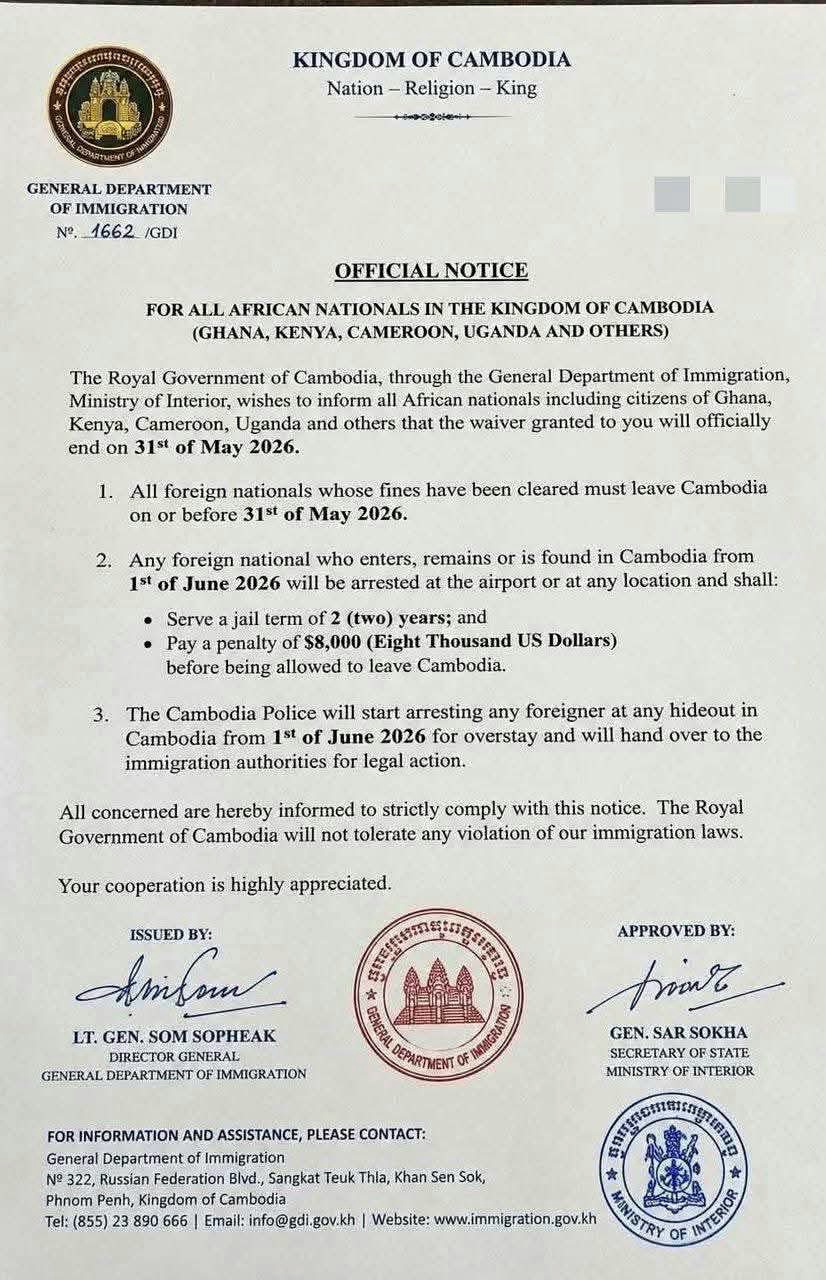
Cambodia has delivered a blunt message to African nationals living in the country. The Southeast Asian nation has ordered citizens from Ghana, Kenya, Cameroon, Uganda, and several other African countries to leave by May 31, 2026, after a temporary immigration waiver expired. From June 1 onward, anyone who remains illegally faces arrest, up to two years in prison, fines of up to 8,000 dollars, and consequent deportation. This is not subtle diplomatic language. It is a firm exercise of national sovereignty by a country that has clearly decided enough is enough.
This decision has sparked heated discussion across Africa and beyond. While some condemn Cambodia for the move, others recognize a simple truth: every nation has the right to control its borders and decide who stays within them. Cambodia is simply enforcing rules that many Western countries talk about but often fail to uphold.
The Details Of Cambodia’s Decision
The General Department of Immigration under Cambodia Ministry of Interior issued the notice. It specifically targets foreign nationals who benefited from a temporary immigration waiver. The waiver, which apparently allowed some Africans to remain despite previous irregularities or fines, ends on May 31, 2026. Those who have cleared any outstanding fines must depart by that date. Failure to comply will trigger strict enforcement starting June 1, 2026.
Authorities made clear that overstayers will face serious consequences: arrest by police, prosecution under immigration laws, potential imprisonment for up to two years, substantial financial penalties, and mandatory deportation. This is zero-tolerance enforcement, not empty rhetoric.
Cambodia has dealt with issues related to illegal immigration, scam compounds, and criminal networks involving foreign nationals in recent years. African migrants, along with others, have been linked to some of these problems in certain areas. The government appears determined to regain control and send a clear signal that its hospitality has limits.
A Sovereign Nation Exercises Its Rights
Every country possesses the fundamental right to decide who enters and remains within its borders. Cambodia exercises that right without apology. This action stands in sharp contrast to many Western nations that have allowed mass illegal immigration, only to complain later about the consequences. Cambodia has chosen a different path. It has drawn a firm line and announced consequences for crossing it.
Critics will call this move racist or xenophobic. Such accusations ring hollow. Cambodia is not targeting people based on race. It is targeting individuals who have overstayed their legal permission to remain. Nations across Asia, including Japan, South Korea, and China, maintain strict immigration controls and enforce them rigorously. No one accuses them of bigotry for doing so. Cambodia deserves the same respect for protecting its own people and resources.
This decision also highlights an uncomfortable reality. Mass migration from certain regions has created challenges in many host countries. Crime, cultural clashes, and economic strain often follow large influxes when integration fails. Cambodia has apparently studied these patterns and chosen prevention over regret.
The Double Standard Exposed
Western nations frequently lecture developing countries about human rights and openness while struggling with the consequences of their own lax policies. Europe has seen no-go zones, rising crime rates, and social tensions directly linked to uncontrolled migration from Africa and the Middle East. Canada and the United States face similar pressures along their borders. Yet when a smaller Asian nation like Cambodia enforces basic immigration rules, some voices cry foul.
This reveals a glaring double standard. Sovereign nations in Asia and elsewhere are free to protect their cultural identity and national interests, but Western countries are expected to absorb unlimited numbers of migrants regardless of the cost. Cambodia rejection of this pressure should serve as a model for others. Nations do not owe permanent residency to anyone who arrives and decides to stay.
The African nationals affected by this order had the benefit of a temporary waiver. That generosity has now reached its end. Those who chose to overstay despite knowing the terms have only themselves to blame for the coming consequences.
What This Means For Global Migration Patterns
Cambodia action may encourage other nations to review their own immigration policies. When one country demonstrates the political will to enforce its laws, it challenges the assumption that endless migration is inevitable. Countries facing similar pressures from illegal immigration or criminal networks may take note and act accordingly.
This development also underscores an important truth about migration. People move for opportunity, but host nations are not obligated to provide unlimited opportunity at the expense of their own citizens. Successful immigration requires mutual benefit and respect for the rules of the receiving country. When those rules are ignored, enforcement becomes necessary.
African governments should use this moment to reflect as well. Instead of protesting Cambodia decision, they might focus on creating better conditions at home so their citizens do not feel compelled to seek uncertain futures abroad. Brain drain and illegal migration harm developing nations as much as they strain host countries.
A Model Of Responsible Sovereignty
Cambodia has shown that a nation can be firm without being cruel. The deadline gives people time to arrange their departure. The penalties, while strict, follow clear rules announced in advance. This is governance with backbone, something sorely lacking in many parts of the world today.
As June 1 approaches, the world will watch to see how strictly Cambodia enforces its ultimatum. If the government follows through, it will send a powerful message across Southeast Asia and beyond: borders matter, laws matter, and sovereignty is not negotiable.
Nations that respect their own people enough to control immigration tend to maintain stronger social cohesion and economic stability. Cambodia appears to understand this. Other countries would do well to learn from the example rather than condemn it.
The coming days will test Cambodia resolve. They will also test the international community willingness to accept that not every nation wants to become a destination for unlimited migration. Sovereignty includes the right to say no.
This is not the end of migration into Cambodia, but it marks a significant reset. A nation has looked at the situation on the ground and chosen to protect its interests. That decision deserves respect, not outrage.